

Camazotz
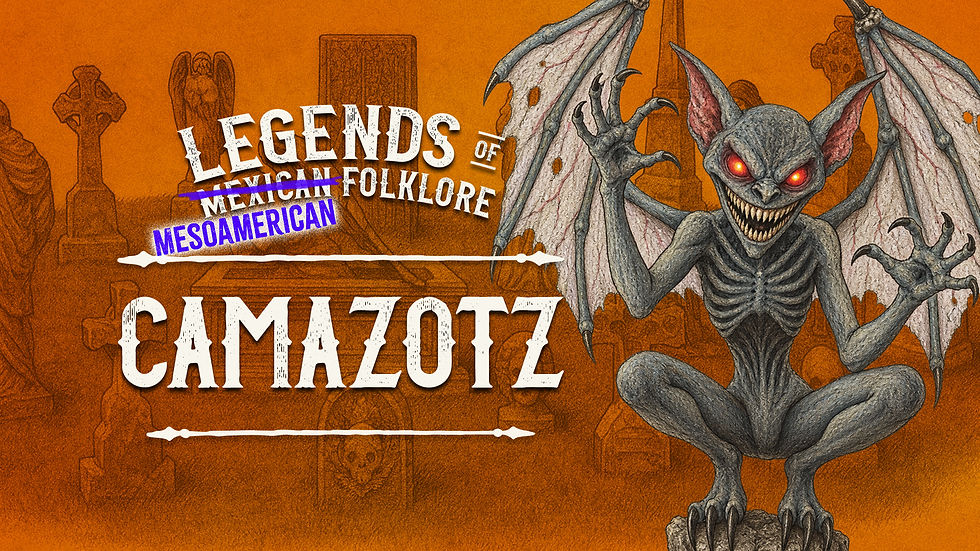
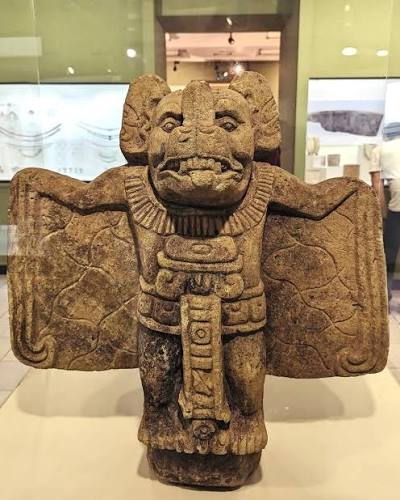
Should you find yourself in the Maya underworld of Xibalba, you may just encounter Camazotz, a creature with the body of a small man, leathery wings, large pricked ears and razor talons. His name can be translated as "Death Bat" and he guards the liminal boundary between the living world and the underworld. This legend transcends borders throughout Mesoamerica.
The House of Bats
The story of Camazotz as it appears in the Popol Vuh, an ancient text of the K’iche’ people of Guatemala, is vicious. Two inquisitive brothers were lured into Xibalba and were trapped inside a cave crawling with thousands of bats, screeching in a dark so complete you couldn’t see your own hand. The clever brothers hunched down low and hid, quiet as stones, waiting for the sun. All night they held still. But just before dawn, one brother peeked out to see if the sun had crested above the horizon. It hadn't. And in that one breath of impatience, Camazotz sliced off his head with one swipe of a claw, and then used it as a ball.
A God Worth Fearing
That sudden death made an impression and gave credence to much that frightened the Maya. They also believed Camazotz had the power to devour the sun or moon outright, which is how a culture that tracked the sky with obsessive precision explained an eclipse: not an astronomical event, but a bat god eating the light. His shriek and breath were a pestilence ravaging through villages, unseen until it had already arrived. Neighboring communities built shrines and left offerings to bat deities specifically to ward off disease and disaster.
The Bats Behind the Mytth
Cenotes and the caves across the region were believed to be portals into Xibalba. In these caves, very real colonies of vampire bats, some larger and more aggressive than anything alive today, would pour out at dusk to hunt. Generation after generation, people coexisted with these terrifying winged beasts, and they quietly calcified into folklore and tales of god-like monsters.
How Camazotz Became Dracula
When Spanish colonizers plundered the Americas in the early 1500s, they encountered these formidable bats and the folktales that came with them. Something in the European imagination clicked into place. Vampires existed throughout Europe by then, but they were lumbering, slow-moving ghouls closer to blood-sucking zombies. When Bram Stoker sat down in 1897 to write Dracula, he fused the name of the ruthless 15th-century prince, Vlad the Impaler (or Vlad Dracula), with accounts of blood-drinking bats that were already circulating in writings about Latin America. He gave his Dracula the supernatural ability to shapeshift into a bat, forever binding the animal and the mythical monster in popular culture.
A Long Overdue Introduction
Yet we never hear about Camazotz. He handed the modern vampire its teeth, and history filed him away as a footnote. That should bother you a little. A god who could eat the sun, who guarded the actual seam between the living and the dead, who required shrines and offerings from people who feared him for real reasons, deserves better. And as this happens to be Halloween, a time when the veil between worlds is said to be at its thinnest, the passageway where Camazotz stands guard is easier to see. So the next time something with wings crosses in front of the moon, give it a second look. Camazotz is not gone. He was just never properly introduced.
Comments